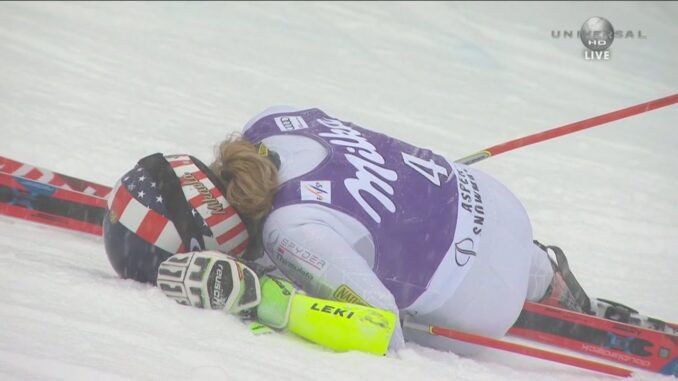
There are moments in sports when an athlete stops feeling like just a competitor and starts feeling like a mirror. A mirror for resilience. A mirror for doubt. A mirror for every person who has ever been told to slow down, step back, or quietly fade away. That is what Mikaela Shiffrin became this past season. Not just a skier chasing medals, but a story unfolding in real time about pain, pressure, and the stubborn refusal to let either define her ending.
For years, dominance followed her like a shadow. The records stacked up. The wins became routine. The podium felt almost expected. When she broke the all time World Cup wins record, it seemed like she had rewritten the boundaries of what was possible in alpine skiing. And yet, what the highlight reels never fully capture is how lonely that kind of greatness can be. Every race becomes a referendum. Every finish line becomes a verdict. The world does not just watch. It waits. It waits for the slip. It waits for the crack. It waits for proof that even legends are fragile.
Then the injury came.
It was not dramatic in the cinematic sense. There was no slow motion hero shot, no swelling orchestral music. Just the cold reality of a body pushed to its limits in a sport where ice does not forgive hesitation. One moment you are carving down a mountain at highway speeds. The next, you are reminded that gravity has no loyalty.
For Mikaela, the injury was not just physical. It interrupted rhythm. It disrupted momentum. It invited questions. Suddenly the conversation shifted. Could she maintain her edge? Would she still be the same skier? Had the years of dominance quietly taken their toll? The same voices that once praised her inevitability began whispering about vulnerability.
And this is where the real story begins.

Because what makes her compelling is not that she wins. It is how she responds when winning is no longer guaranteed.
Rehabilitation is rarely glamorous. It is repetition without applause. It is small, almost invisible victories. A little more range of motion. A little less swelling. A little more strength. For an athlete used to measuring success in hundredths of a second, that shift in perspective can feel suffocating. The mountain is replaced by a training room. The roar of the crowd replaced by the hum of equipment. You confront not your competitors, but your own patience.
In interviews, Mikaela has always been thoughtful, almost disarmingly honest about the mental side of her journey. She has spoken about anxiety, about expectations, about the weight of chasing history while still trying to feel human. So when the injury forced her to slow down, it did not just test her knee or her body. It tested her identity.
Who are you when you cannot race?
For many athletes, that question is terrifying. Their sport is not just what they do. It is who they are. Remove it, even temporarily, and the silence can be deafening.
But something shifted during that time away. Instead of shrinking, she recalibrated. Instead of rushing back to prove something, she leaned into the process. She trained. She rebuilt. She listened to her body in a way that champions often struggle to do. Because the hunger to win can drown out the whisper of caution.
When she finally returned to competition, there was no guarantee of magic. The slopes do not hand out sympathy. The clock does not adjust for narrative. Yet from her first turns back, you could sense a different kind of intensity. Not frantic. Not desperate. Focused. Measured. Almost surgical.
It would have been easy to chase immediate redemption. To ski recklessly in pursuit of a headline that screamed comeback. Instead, she chose precision. She chose patience. And in a sport decided by margins thinner than a blink, that discipline matters.

The results followed.
Not because she forced them. But because she trusted the foundation she had rebuilt. Race after race, she reminded the world that resilience is not loud. It is steady. It shows up in training runs nobody watches. It shows up in the decision to compete when doubt still lingers in the back of your mind.
There is something uniquely powerful about watching a champion fight not for relevance, but for renewal. Mikaela did not need to prove she belonged among the greats. Her résumé already settled that debate. What she was proving now was something deeper. That greatness is not a straight line. It bends. It stumbles. It recalibrates.
And the public noticed.
Social media buzzed with every return. Clips of her carving through gates circulated with captions about redemption and resilience. Fans who had followed her since her teenage breakthrough felt invested in this chapter in a different way. It was no longer just about medals. It was about witnessing evolution.
In a time when sports narratives often move at lightning speed, when one bad race can trend for hours and then be forgotten, her journey demanded patience from her audience too. It asked fans to understand that healing is nonlinear. That even the most decorated athlete can have days where confidence wavers.
There were races where she looked untouchable again, slicing through the course with that familiar blend of aggression and grace. There were others where she finished just off the podium, close but not quite. And those near misses were perhaps more telling than the wins. They revealed an athlete still navigating the thin line between pushing limits and respecting them.
What separates Mikaela is not just technical brilliance. It is emotional intelligence. She has learned to articulate the mental turbulence that many athletes hide. She speaks openly about pressure, about grief, about personal loss, about the complexity of competing at the highest level while carrying an entire country’s expectations.
So when she stands at the start gate now, there is more behind her eyes than strategy. There is perspective.
Perspective changes how you race.
It softens the panic of a small mistake. It steadies the heartbeat when conditions are unpredictable. It reminds you that a career is a mosaic, not a single tile. One injury does not erase years of mastery. One setback does not cancel legacy.
As the season unfolded, something else became clear. Her competitors were not just racing against a record holder. They were racing against someone who had rediscovered hunger. Not the hunger of proving critics wrong, but the hunger of gratitude. Gratitude to be healthy enough to compete. Gratitude to feel skis under her feet again. Gratitude for the simple privilege of standing in the start gate.
That kind of motivation is dangerous in the best possible way.
And then came the performances that silenced lingering doubt. The runs where she attacked the course with calculated ferocity. The finishes where the clock flashed her name at the top. The crowd rising. Commentators scrambling for fresh superlatives. It was not just a return. It was a statement.
She was never gone.
But perhaps the most compelling part of this chapter is what it signals for the future. The upcoming Olympic cycle looms large. The world will once again turn its attention to the grandest stage in winter sports. And the narrative will inevitably circle back to her. Can she add more gold? Can she extend the record? Can she cement an era that feels almost mythic?
Those questions are inevitable. But if this season taught us anything, it is that Mikaela Shiffrin’s story cannot be reduced to medal counts.
It is about adaptation.
It is about vulnerability without surrender.
It is about the quiet, relentless decision to continue.
In a culture obsessed with instant comebacks and dramatic arcs, her journey offers something more authentic. Healing takes time. Confidence rebuilds slowly. Trusting your body again after injury is not a switch you flip. It is a relationship you renegotiate.
And she renegotiated it with patience.
The beauty of watching her now is seeing an athlete who understands both her power and her limits. That balance is rare. Some competitors burn out chasing invincibility. Others fade when adversity strikes. She has managed to integrate both triumph and setback into a single, evolving identity.
Fans feel that. You can see it in the comments. In the shared clips. In the long threads dissecting each run. There is admiration, yes. But there is also connection. Because resilience resonates beyond sport. People see in her something familiar. The need to rebuild after disruption. The courage to show up again even when the outcome is uncertain.
And perhaps that is why her story continues to spread so quickly online. Not because she wins. But because she reflects something universal.
The mountain will always be unforgiving. The gates will always demand precision. The margins will always be ruthless. But Mikaela Shiffrin has proven that what defines a champion is not immunity to falling. It is the refusal to stay down.
This latest chapter is not a fairy tale. It is better. It is real. It is layered. It carries scars and self doubt and hard earned confidence. It shows that dominance can evolve into something richer than inevitability. It can become wisdom.
As she looks ahead to the next races, the next season, the next Olympic horizon, one thing feels certain. The conversation around her will continue. The expectations will remain heavy. The spotlight will not dim.
But if the injury taught her anything, it is that the spotlight is not what sustains you. The work does. The grind does. The quiet mornings on snow when nobody is watching do.
And that is why counting her out was always a mistake.
Because champions are not defined by how long they stand at the top. They are defined by how they climb back when they slip. And Mikaela Shiffrin has shown, once again, that her greatest strength is not speed alone.
It is resilience.
And that is a story the world never gets tired of sharing.
Leave a Reply