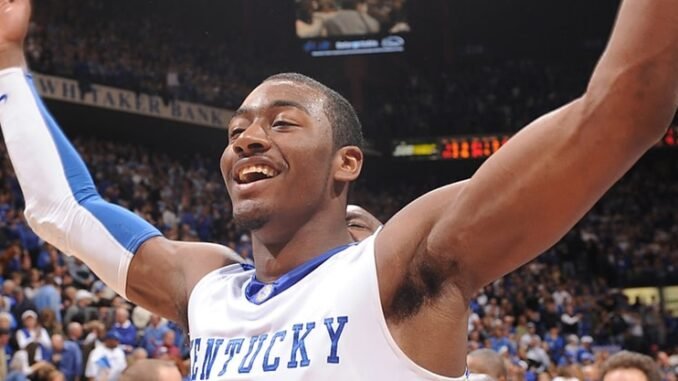
A Farewell to a Legend: How John Wall’s Journey Made Him Forever Kentucky
You just had to be there.
For Kentucky fans, for college basketball diehards, for anyone who remembers the electricity of Rupp Arena in the fall of 2009, the arrival of John Wall was more than a commitment it was a revolution.
When John Calipari took over at Kentucky in the spring of that year, the program stood at a crossroads. Once mighty, the Wildcats had grown stagnant, weighed down by a season of disappointment under Billy Gillispie. Calipari promised change, but no one could have imagined just how quickly and completely that promise would be fulfilled. The moment John Wall chose Kentucky over Miami, Duke, and North Carolina, the tide turned. He wasn’t just the crown jewel of Cal’s first class; he was the cultural spark that reintroduced Kentucky as the program in college basketball.
And then came Big Blue Madness, October 16, 2009 the night Kentucky basketball felt alive again.
The spotlight swept across the rafters of Rupp. Dorrough’s “Ice Cream Paint Job” rattled through the speakers. Then, the words:
A 6-4 freshman from Raleigh, North Carolina, number 11, John Wall.
He flexed, he danced, he smiled and instantly, he owned the night. The John Wall Dance became a national craze before he had even played a single college minute. For a fanbase craving swagger, for a program desperate to feel cool again, Wall was the answer. He was aura before aura was even a word.
But it wasn’t all show. His game backed up every ounce of hype. Wall’s debut brought a game-winner against Miami (OH). Weeks later, he led Kentucky past North Carolina and UConn in back-to-back wins that announced the Wildcats were not just back, but terrifying. With 16.6 points and 6.5 assists per game, he powered Kentucky to 35 wins, an SEC title, and the Elite Eight. He became SEC Player of the Year, a consensus All-American, National Player of the Year, and eventually, the first No. 1 overall NBA draft pick in Kentucky history.
The blueprint was born. Calipari’s one-and-done era became reality because Wall proved it could work: team success and individual stardom weren’t mutually exclusive. The names on the back of the jersey could thrive without overshadowing the name on the front. Players could stop in Lexington, make a Final Four push, then chase NBA dreams — all while leaving a permanent mark on Big Blue Nation.
For Wall, the NBA years brought stardom, wealth, and heartbreak. He was a five-time All-Star, a $267 million earner, the face of Reebok, then adidas, with signature sneakers and his own anthem, Troop 41’s “Do the John Wall.” He was, for a time, one of the fastest, most unstoppable point guards in the game. Washington, D.C. belonged to him.
But the game, cruel as it often is, struck back. Injuries stole his prime. An Achilles tear, surgeries, setbacks the brilliant flame dimmed. And yet, John Wall remained. He found new battles to fight, including his most difficult: a near-fatal mental health crisis after the death of his mother and grandmother. He opened up about depression and suicidal thoughts, sharing how therapy and his two sons saved him. The same man who once made kids dance in their living rooms now used his voice to remind people that vulnerability is strength.
And through it all, Kentucky never stopped being home.
In 2017, during his UK Hall of Fame induction, Wall broke down in tears, speaking about his mother’s sacrifices the light bills she let go unpaid so he could play AAU basketball, the faith she never lost in him. In 2024, as Calipari departed Kentucky for Arkansas and the fanbase split into camps of loyalty and frustration, Wall became the bridge. He refused to choose sides. He praised his coach while reminding Big Blue Nation that his jersey, his tattoo, his heart all still belonged to Kentucky.
“It’s always home,” Wall said. “Always family.”
When Mark Pope took over the program, Wall made it easy for fans to breathe again. He introduced himself to the new coach, showing respect, while still dapping up Cal moments later. No sides, no bitterness only love. He understood something fans often forget: time moves on, but the bond between a player and Kentucky is eternal.
That’s why this farewell feels so bittersweet. On August 19, 2025, at age 34, John Wall officially walked away from the game. The ball won’t dribble for him anymore, but the memories will echo forever in Rupp Arena, in mixtapes, in highlight reels, in the hearts of the fans who lived through it.
Wall was the first superstar of Calipari’s era, the one who showed what was possible. He gave Kentucky swagger again. He danced, he won, he smiled, he cried. And now, in his own way, he’s left the stage not with bitterness, but with gratitude.
The John Wall era at Kentucky lasted only one year on the floor but in reality, it has lasted 16 years and counting. Every recruit who followed in his footsteps, every Wildcat who came to Lexington to chase dreams, has walked a trail he blazed.
Forever No. 11. Forever a Wildcat. Forever Kentucky.
And when Big Blue Nation looks back decades from now, they’ll still say it the same way they said it then:
You just had to be there.
Leave a Reply