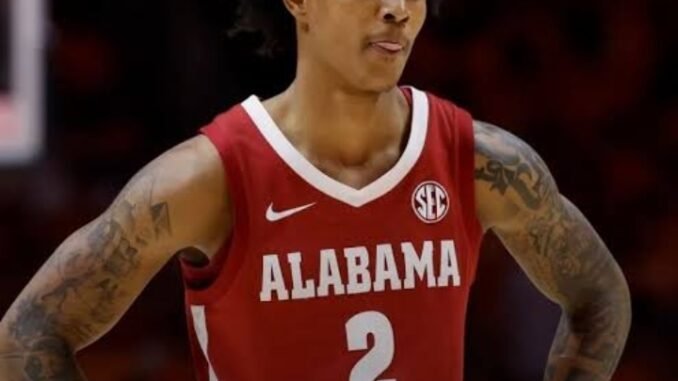
Fall From the Spotlight: Alabama Star Aden Holloway Arrested on Felony Narcotics Charges
In the high-stakes world of college basketball, where momentum, discipline, and timing often define success, few moments can derail a team’s aspirations as abruptly as a scandal involving one of its key players. Such is the case for Aden Holloway, the Alabama Crimson Tide’s second-leading scorer, whose recent arrest on felony narcotics charges has sent shockwaves through the program, its fan base, and the broader NCAA basketball community.
Just days before the start of the 2026 NCAA Tournament one of the most anticipated events in college sports Holloway’s arrest has not only raised serious legal and personal questions but has also forced the Alabama program into an unexpected period of adjustment at a critical juncture of the season.
The Arrest That Shook Alabama Basketball
On the morning of March 16, 2026, law enforcement officials from the West Alabama Narcotics Task Force executed a search warrant at a residence near the University of Alabama campus. During the search, authorities reportedly discovered more than a pound of marijuana, along with paraphernalia and cash.
Holloway, a 21-year-old junior guard, was taken into custody shortly thereafter and charged with first-degree possession of marijuana (not for personal use) and failure to affix a tax stamp, both of which are classified as felonies under Alabama law.
The seriousness of these charges cannot be overstated. In Alabama, a conviction for first-degree marijuana possession can carry penalties of up to 10 years in prison and fines reaching $15,000, underscoring the gravity of the situation facing the young athlete.
Following his arrest, Holloway was booked into Tuscaloosa County Jail and later released on a $5,000 bond.
Immediate Fallout: Suspension and Removal from Campus
The University of Alabama acted swiftly in response to the incident. In an official statement, the university confirmed that Holloway had been removed from campus pending an investigation by the Office of Student Conduct.
Simultaneously, Alabama head coach Nate Oats announced that Holloway had been suspended indefinitely, emphasizing that the program maintains strict standards of accountability.
Oats addressed the situation candidly, expressing disappointment while also signaling support for the player:
“We’ve got standards in our program… We’re certainly disappointed… but we’re helping him get the help that he needs.”
This dual response discipline combined with support reflects the delicate balance college programs often attempt to strike when dealing with off-court issues involving student-athletes.
A Key Player Lost at the Worst Possible Time
The timing of Holloway’s arrest could hardly be worse for Alabama. As the team prepared for its opening-round matchup in the 2026 NCAA Tournament against Hofstra, the loss of its second-leading scorer represents a significant blow.
Holloway had been a cornerstone of Alabama’s success throughout the season. Averaging 16.8 points per game, he ranked second on the team in scoring and was one of its most reliable offensive weapons.
Beyond scoring, Holloway was also a leader in perimeter shooting, hitting over 40% of his three-point attempts and stretching defenses with his range.
With Alabama entering the tournament as a No. 4 seed and riding a wave of strong performances, his absence forces the team to recalibrate its strategy and rotation at the most critical stage of the season.
Coach Oats acknowledged the challenge but expressed confidence in his roster’s depth, noting that the team has previously adapted to lineup changes throughout the season.
Legal and Cultural Context: Why the Charges Matter
While marijuana laws have been relaxed in many parts of the United States, Alabama maintains relatively strict regulations, particularly regarding possession with intent beyond personal use.
The distinction between personal use and distribution-related possession is key. Authorities cited the quantity of marijuana and the presence of packaging materials as factors contributing to the felony classification.
Additionally, the charge of failure to affix a tax stamp a lesser-known but serious offense relates to Alabama’s requirement that certain controlled substances carry tax documentation. Its inclusion further complicates Holloway’s legal situation.
Interestingly, this case also highlights a broader contradiction within collegiate athletics: while the NCAA removed marijuana from its list of banned substances for some championships in recent years, state laws continue to govern criminal liability.
Impact on Team Dynamics and Tournament Outlook
Alabama now faces a difficult question: how to move forward without one of its most productive players.
The Crimson Tide had built momentum late in the season, winning nine of their last eleven games and positioning themselves as a dangerous tournament contender.
However, Holloway’s absence reduces backcourt depth and places additional pressure on remaining guards to step up. Players such as Houston Mallette and others are expected to take on expanded roles, but replacing Holloway’s scoring and playmaking will not be easy.
From a tactical standpoint, Alabama may need to:
- Adjust offensive schemes to compensate for lost perimeter shooting
- Rely more heavily on frontcourt production
- Increase defensive intensity to offset offensive gaps
The psychological impact cannot be ignored either. Sudden disruptions can either fracture a team or galvanize it. How Alabama responds in the opening round will reveal much about its resilience and leadership.
The Human Element: A Young Athlete at a Crossroads
Beyond the headlines and statistics lies a deeper, more personal story. At just 21 years old, Holloway is navigating a pivotal moment in his life one that could shape his future both on and off the court.
Highly touted as a recruit and recognized as a McDonald’s All-American, Holloway’s career trajectory had been on a steady upward path.
Now, that trajectory faces uncertainty.
Legal proceedings will determine the outcome of his case, but the broader implications reputation, career opportunities, and personal growth are already in motion.
Coach Oats’ comments suggest that the program intends to support Holloway through this period, emphasizing rehabilitation and accountability rather than abandonment.
Media Attention and Public Reaction
The arrest has drawn widespread media coverage, reflecting both Holloway’s prominence and the timing of the incident.
Reports have detailed everything from the specifics of the search to the potential legal consequences and the immediate impact on Alabama’s tournament plans.
Public reaction has been mixed. Some fans have expressed disappointment and frustration, while others have called for understanding and support for a young athlete facing serious challenges.
Conclusion: A Moment of Reckoning for Player and Program
The arrest of Aden Holloway represents more than just an isolated incident it is a moment of reckoning for both the player and the Alabama basketball program.
For Holloway, the road ahead will be defined by legal outcomes, personal accountability, and the choices he makes moving forward. Whether he can rebuild his career will depend not only on talent but also on growth and responsibility.
For Alabama, the challenge is immediate and tangible: navigating the NCAA Tournament without a key contributor while maintaining focus and cohesion. The program’s response will serve as a test of its culture, depth, and resilience.
In the broader context of college athletics, this incident serves as a reminder of the pressures and pitfalls faced by young athletes operating under intense scrutiny. Talent may open doors, but discipline and decision-making ultimately determine how far one can go.
As the tournament unfolds and the legal process continues, one thing is certain: the story of Aden Holloway is far from over.
Leave a Reply