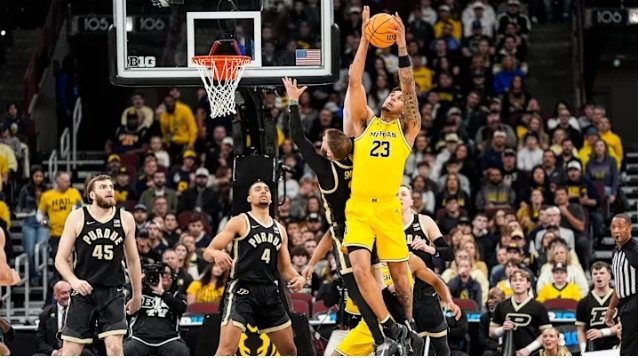
Beyond the Money: How Yaxel Lendeborg’s Remarks Exposed the Real Issue in Kentucky’s Recruiting Struggles
Introduction: A Recruitment That Sparked a Bigger Conversation
In modern college basketball, few topics generate as much debate as recruiting especially when elite programs fail to land top-tier talent. When Yaxel Lendeborg, one of the most sought-after players in the transfer portal, ultimately chose Michigan Wolverines men’s basketball over Kentucky Wildcats men’s basketball, the immediate reaction among fans and analysts was predictable: something must have gone wrong behind the scenes.
Many pointed fingers at Kentucky’s NIL structure, particularly its partnership with JMI Sports, suggesting that institutional limitations might have cost the Wildcats a generational talent. However, Lendeborg’s own remarks and the broader context surrounding his recruitment tell a very different story. Rather than confirming the popular narrative, his comments reveal that Kentucky’s recruiting issue is far more nuanced and cannot simply be blamed on JMI or financial constraints.
This article explores what really happened, what Lendeborg’s decision signifies, and why Kentucky’s recruiting challenges may be rooted in deeper structural and philosophical shifts in college basketball.
The Rise of Yaxel Lendeborg: A Coveted Talent
Before diving into the controversy, it is essential to understand the caliber of player Kentucky was pursuing.
Lendeborg emerged as one of the most dominant and versatile players in college basketball during his time at UAB. Averaging 17.7 points, 11.4 rebounds, and contributing across every statistical category, he quickly became one of the most complete forwards in the country.
His dominance earned him recognition as:
- A top-ranked transfer portal player
- A two-time Defensive Player of the Year in his conference
- A legitimate NBA prospect
By the time he entered the transfer portal, nearly every major program in the country including Kentucky was aggressively pursuing him.
For Kentucky, landing Lendeborg would have been more than just a roster addition; it would have been a statement.
Kentucky’s Pursuit: Aggressive, Serious and Expensive
Contrary to the belief that Kentucky’s NIL setup held them back, reports indicate that the Wildcats were not only competitive financially they were extremely aggressive.
According to discussions surrounding Lendeborg’s recruitment, Kentucky allegedly offered between $7 million and $9 million in NIL-related compensation.
Even if exact figures remain debated, the implication is clear:
Kentucky was willing to spend at the highest level of the market.
This alone dismantles the idea that JMI or Kentucky’s NIL infrastructure was incapable of competing financially. Programs do not make offers of that magnitude if they are structurally limited.
So if money was not the issue, what was?
The JMI Narrative: A Convenient but Incomplete Explanation
JMI Sports has often been cited as a potential bottleneck in Kentucky’s NIL ecosystem. Some critics argue that long-term agreements and centralized structures can slow down deal-making or limit flexibility.
However, Lendeborg’s situation challenges that assumption.
If Kentucky truly offered multi-million-dollar compensation packages, then:
- The program clearly had access to significant NIL resources
- The infrastructure was functional enough to compete at the highest level
- The problem lies elsewhere
Blaming JMI becomes an oversimplification a convenient explanation for a more complex issue.
Why Lendeborg Chose Michigan
Lendeborg’s decision to join Michigan was not just about money it was about fit, vision, and opportunity.
At Michigan, he saw:
- A system that maximized versatility
- A coaching philosophy aligned with his skill set
- A clear developmental pathway to the NBA
Reports suggest that he was particularly drawn to how Michigan utilized players like Danny Wolf allowing big men to handle the ball, create plays, and operate in space.
This is crucial.
In today’s college basketball landscape, elite players are not just asking, “How much will I earn?”
They are asking:
- How will I be used?
- Will this system elevate my draft stock?
- Does this coach understand my game?
Michigan answered those questions more convincingly than Kentucky.
The Real Issue: Fit Over Finances
What Lendeborg’s remarks ultimately reveal is that Kentucky’s recruiting challenges are not about money they are about alignment.
The Wildcats, historically dominant in recruiting, are now operating in a new era where:
- Players have more autonomy
- Transfers dominate roster construction
- Development matters as much as exposure
In this environment, simply being Kentucky is no longer enough.
Programs must:
- Present a clear identity
- Offer role clarity
- Demonstrate adaptability
If a player feels uncertain about how they fit into a system, even the most lucrative offer may not be enough.
The Evolution of College Basketball Recruiting
NCAA Division I Men’s Basketball has undergone a dramatic transformation in recent years.
Key changes include:
- The rise of NIL deals
- The transfer portal revolution
- Increased player empowerment
These shifts have redefined recruiting priorities.
In the past:
- Prestige and exposure dominated decisions
Now:
- Development, system fit, and trust are equally important
Lendeborg’s choice reflects this evolution.
Fan Reactions and Misconceptions
Among Kentucky fans, frustration quickly turned into blame often directed at NIL structures like JMI.
But this reaction overlooks a key reality:
recruiting losses are rarely caused by a single factor.
As discussions online suggest, even when massive offers are on the table, players may still choose programs that better align with their goals.
The assumption that “more money guarantees success” is increasingly outdated.
What Kentucky Must Learn Moving Forward
For Kentucky to reclaim its dominance in recruiting, it must adapt not just financially, but philosophically.
Key areas of improvement include:
1. Clear System Identity
Players need to understand exactly how they will be used.
2. Developmental Transparency
Programs must demonstrate a proven track record of preparing players for the NBA.
3. Relationship Building
Trust between coaches and players is more important than ever.
4. Adaptability
Rigid systems no longer work in a player-driven era.
Conclusion: A Wake-Up Call, Not a Crisis
Yaxel Lendeborg’s recruitment was not a failure of resources it was a reflection of a changing landscape.
Kentucky did not lose him because of JMI.
They lost him because another program offered something more compelling: clarity, fit, and vision.
In many ways, this is not a crisis but a wake-up call.
The Wildcats still possess:
- Elite resources
- A historic brand
- A passionate fan base
But in today’s college basketball world, those advantages must be paired with adaptability and strategic clarity.
Lendeborg’s remarks serve as a reminder that recruiting is no longer just about winning bids it is about winning belief.
And until Kentucky consistently offers both, similar outcomes may continue to follow.
Leave a Reply