
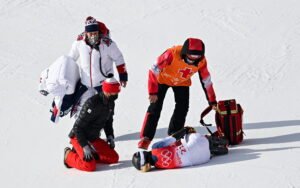
There is a moment in every athlete’s life when the noise grows louder than the cheers. The whispers start small at first. Maybe she will not be the same. Maybe this is where it changes. Maybe this is where it slows down. For Mikaela Shiffrin, that moment came after injury, when the world that once celebrated her dominance suddenly began questioning her durability. The narrative shifted almost overnight. The focus was no longer on records or medals. It was on recovery timelines, on caution, on whether the mountain would still feel the same beneath her skis.
But what many people misunderstand about greatness is this. It is rarely loud when it rebuilds itself. It is quiet. It is patient. It is stubborn.
Mikaela Shiffrin has never been just a collection of statistics. Yes, she is one of the most decorated alpine skiers in history. Yes, she has stood atop podiums across continents and carved her name into the sport in a way few ever have. But the deeper story has always been about her relationship with the work. The hours before sunrise. The repetition. The discipline that feels almost invisible to outsiders. When injury interrupted her rhythm, it did not erase that foundation. It challenged it.
After the setback, many assumed she would need to pull back. That she would ski more cautiously. That perhaps she would focus only on certain events. That the days of relentless dominance might be behind her. It is a common script in sports. An athlete reaches incredible heights, suffers a physical interruption, and returns slightly diminished. Not weak. Not irrelevant. Just a step slower than before.
But Shiffrin has never followed predictable scripts.
Rehabilitation is not glamorous. There are no crowds. No medals. No dramatic finishes. There are quiet rooms. There are exercises that feel repetitive and small. There are days when progress is measured in millimeters rather than miles. For an athlete accustomed to flying down icy slopes at breathtaking speeds, that kind of stillness can be its own challenge.
Yet those close to her often speak about her mental discipline. About the way she approaches skiing not just as competition but as craft. Injury forced her to slow down physically, but mentally she leaned in even harder. She studied. She reflected. She reconnected with the fundamentals that had built her career from the beginning.
In elite alpine skiing, precision is everything. A fraction of a second can separate gold from fourth place. A slight shift in balance can change an entire run. When Shiffrin returned to training, she did not rush the process. She rebuilt her movements deliberately. Edge by edge. Turn by turn. The mountain demands respect, and she gave it that respect fully.
What made her comeback powerful was not just speed. It was composure.
When she stepped back into competition, there was a visible steadiness about her. Not reckless ambition. Not desperation to prove a point. Instead there was clarity. The kind that only comes from facing uncertainty and choosing to move forward anyway. Each run carried the quiet message that she was not defined by a single setback.

Athletes at her level operate in a world of expectations. Fans expect victories. Media expect headlines. Sponsors expect consistency. Injury disrupts that ecosystem. Suddenly the questions become sharper. Is she still at her peak. Can she handle the pressure. Is the next generation ready to take over.
Shiffrin answered those questions not in interviews but on the snow.
Her technique remained as fluid as ever. The rhythm of her slalom runs still had that unmistakable blend of aggression and grace. The giant slalom courses that once tested her patience became canvases again for her precision. It was not just that she was winning or contending. It was how she was doing it. Calm. Calculated. Present.
There is something deeply compelling about an athlete who refuses to let adversity dictate the narrative. In Shiffrin’s case, the injury could have been framed as the beginning of decline. Instead it became a chapter of refinement. She did not return to prove doubters wrong in a dramatic, emotional outburst. She returned to ski. To compete. To pursue excellence in the same steady way she always had.
Greatness often reveals itself in resilience.
For younger athletes watching, her response offered a lesson far beyond podium finishes. It showed that setbacks do not erase identity. That slowing down temporarily does not mean stopping. That patience can coexist with ambition. In a culture that often celebrates immediate comebacks and miraculous turnarounds, Shiffrin’s path felt grounded. Real. Earned.
She has spoken in the past about the mental side of competition. About pressure. About expectations. Injury adds another layer to that mental landscape. The body must heal, but so must confidence. Trusting the same knee or the same movement again at high speed requires courage. It requires repetition until doubt fades into instinct.
Watching her return to form, it was clear that the trust was there.
Her edges bit into the snow with familiar authority. Her transitions between gates were crisp and intentional. She looked not like an athlete surviving, but like one fully engaged in her craft. That distinction matters. Survival suggests fear. Engagement suggests purpose.
The mountains where she competes are unforgiving. Conditions change. Weather shifts. Courses vary. There is no guarantee of smooth runs or ideal circumstances. Perhaps that unpredictability mirrors the arc of her career. Triumph. Loss. Injury. Comeback. Through it all, one constant remains. Commitment.
Fans who followed her journey saw more than statistics stacking up again. They saw maturity. They saw an athlete who understands that legacy is not built solely on victories but on responses. Anyone can shine when everything aligns perfectly. It takes something deeper to shine after disruption.
Her story also challenges a broader narrative about female athletes and longevity. Too often, the assumption is that dominance has a short window. That sustaining excellence over years is nearly impossible. Shiffrin continues to challenge that assumption. She evolves. She adapts. She studies her own performance with almost scientific curiosity.
In interviews, she rarely centers herself as a hero. She speaks about team. About coaches. About preparation. That humility adds depth to her resilience. There is no theatrical comeback speech. No dramatic declaration. Just consistent work.
When people said she might slow down after injury, perhaps they underestimated the foundation she had built long before it happened. You cannot manufacture that kind of discipline overnight. It is forged in childhood training sessions. In early competitions. In years of incremental improvement.
The comeback did not erase the injury. It contextualized it.
In sport, injuries are inevitable. The body is pushed to its limits. The difference between a champion and a fleeting talent often lies in what happens afterward. Do they retreat. Do they return cautiously. Or do they return smarter.
Shiffrin returned smarter.
Her strategy on courses reflected experience layered onto skill. She did not chase reckless margins. She chose efficiency. She trusted her preparation. The results followed naturally. Podiums returned. Victories followed. Records continued to grow. But the deeper victory was internal.
It is easy to celebrate an athlete when everything goes right. It is more meaningful to appreciate the arc when things go wrong and then right again. Shiffrin’s journey through injury and back into dominance reinforces a simple but powerful truth. Excellence is not a straight line.
For aspiring athletes, her story is not just about medals. It is about mindset. When forced to slow down physically, she accelerated mentally. She invested in recovery. She honored the process. She refused to let fear dictate her pace.
The mountain does not care about reputation. Every run begins at zero. That is part of what makes her resilience so compelling. No matter how many titles she carries, she must still push off from the start gate like everyone else. Injury or not, history offers no shortcuts.
And yet, she continues to rise.
There is something poetic about watching an athlete reclaim momentum after uncertainty. The turns seem sharper. The focus seems deeper. The appreciation feels stronger. Injury has a way of clarifying priorities. For Shiffrin, it appears to have sharpened her connection to the sport itself.
She was supposed to ease back. To protect. To manage expectations.
Instead, she reminded the world why she became one of the defining figures in alpine skiing. Not because she never fell. Not because she avoided hardship. But because she absorbed it and returned with clarity.
In the broader conversation about legacy, moments like this matter as much as championships. They reveal character. They reveal perspective. They show that greatness is not fragile. It bends. It adapts. It persists.
As seasons continue and younger competitors emerge hungry for their own place in history, Shiffrin’s presence remains steady. She does not ski as someone clinging to past glory. She skis as someone fully engaged in the present.
The injury that was supposed to slow her down became, in many ways, a catalyst. It deepened her resilience. It refined her approach. It expanded her story beyond simple dominance into something more textured and human.
And perhaps that is why her comeback resonates so strongly. It is not just about winning again. It is about reclaiming rhythm. About trusting the body. About facing doubt and choosing discipline instead.
In a world eager to write endings prematurely, Mikaela Shiffrin continues to write chapters. Each run adds nuance. Each season adds dimension. Injury did not close the book. It introduced a plot twist. And she responded not with fear, but with focus.
She was expected to slow down.
Instead, she steadied herself, leaned forward, and carved her way back into the narrative on her own terms.
That is not just resilience.
That is mastery.
Leave a Reply