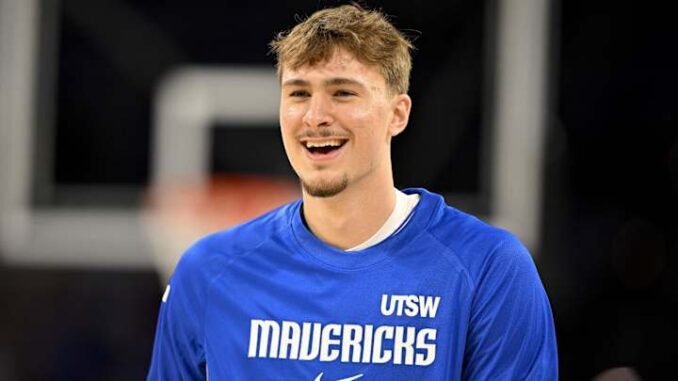
ESPN Says the Quiet Part Out Loud About Cooper Flagg’s Rookie Season — He Doesn’t Need to Score to Be Great
The hype train has officially left the station and the conductor’s name is Cooper Flagg.
In a league obsessed with scoring highlights, viral crossovers, and box-score fireworks, ESPN just admitted something that everyone watching the Dallas Mavericks’ preseason debut quietly felt: Flagg doesn’t need to score 30 points to dominate an NBA game.
That statement alone changes everything we thought we knew about rookies and especially about this one.
The ESPN Moment That Set the Tone
During a recent episode of Brian Windhorst & The Hoop Collective, ESPN insiders Brian Windhorst, Tim Bontemps, and Tim MacMahon broke down Flagg’s first preseason appearance against the Oklahoma City Thunder.
MacMahon’s words said it all the kind that makes you pause, rewind, and realize you’re witnessing something different:
“I don’t know if Cooper Flagg is ever going to be an offensive superstar. I’m not saying he can’t be. I’m saying he can be a superstar without being a 25 or 30-point-per-game scorer.”
In today’s NBA, where offensive numbers define stardom, that’s a revolutionary take and one ESPN isn’t known to hand out lightly.
What MacMahon and his colleagues saw wasn’t just potential; it was a player who understands the game at a veteran level before even playing a regular-season minute.
The Defense That Changes Everything
Flagg’s first defensive possession set the tone. An early block on Isaiah Joe clean, confident, and perfectly timed was a warning shot to every opposing forward in the Western Conference.
This wasn’t luck. It was anticipation. Instinct. Film study.
Flagg doesn’t just defend; he disrupts ecosystems. When he’s on the court, the spacing collapses for opponents. His rotations are sharp, his closeouts are disciplined, and his hands? They never stop moving.
In a league where defense often comes as an afterthought for young players, Flagg treats it as an art form.
It’s no wonder that the Mavericks’ defensive rating spiked every time he was on the floor. He held his matchup to just 12% shooting (1-for-8) a stat line that feels more like a veteran stopper than a rookie debut.
The Passing That ESPN Couldn’t Ignore
Even more striking, though, was Flagg’s feel for the game.
On offense, he wasn’t hunting for shots; he was creating them. The passes were crisp, timely, and bold threading the needle through traffic, anticipating cuts before they happened. It didn’t take long for ESPN to call him “the best passer on the Mavericks roster.”
That’s not hyperbole.
With D’Angelo Russell spacing the floor and Klay Thompson lurking for open looks, Flagg’s playmaking has already begun to rewire Dallas’s offensive rhythm. His vision makes everyone around him better something the Mavericks haven’t had since Luka Dončić’s departure.
One scout put it best after the game:
“He moves like he’s been in the league for five years. The ball just finds energy around him.”
A Future Built on Balance
Flagg doesn’t just bring stats he brings symmetry.
Pairing him with Anthony Davis could quietly become one of the most devastating two-way duos the NBA has seen since Tim Duncan and Kawhi Leonard. Flagg’s ability to stretch the floor, handle the ball, and protect the rim means Dallas can deploy lineups that are both enormous and fluid a nightmare for anyone trying to game-plan against them.
And the scary part? He’s still learning.
The chemistry between Flagg and Davis already hints at something special a pick-and-roll dynamic where both can score, both can pass, and both can defend multiple positions. It’s basketball evolution unfolding in real time.
From Team USA to the NBA: The Confidence of a Prodigy
This poise didn’t come from nowhere.
Before his NBA debut, Flagg was lighting up scrimmages with Team USA during the 2024 Olympic preparations holding his own, and at times outplaying grown men who were preparing to win gold.
At just 17, he was already battling Anthony Davis, Kevin Durant, and Jayson Tatum and looking like he belonged. Those practices hardened him. By the time he stepped into a Mavericks jersey, he’d already faced the best in the world.
Now, at 18, that confidence radiates from every possession.
The Beginning of a New Era
There’s something quietly revolutionary about Flagg’s debut.
He’s not the loud, chest-pounding rookie chasing highlight reels. He’s methodical. Composed. A student of the game who controls tempo, space, and momentum.
That’s what makes ESPN’s recognition so powerful they’re acknowledging that greatness doesn’t have to scream. Sometimes, it just shows up everywhere.
Dallas fans should soak this in. Because what we saw against the Thunder wasn’t just promise it was a preview.
If Flagg can impact games this profoundly without being the primary scorer, imagine what happens when he starts adding layers to his offensive arsenal.
The Quiet Part Out Loud
For years, analysts have chased the next LeBron, the next Durant, the next face of the league.
But maybe the next big thing doesn’t fit that mold at all. Maybe he’s a hybrid a cerebral defender, a selfless passer, and a teenager who sees the game two steps ahead.
Cooper Flagg isn’t chasing numbers. He’s chasing control.
And when a rookie can control a game this effortlessly? That’s when you know the NBA just changed.
Leave a Reply