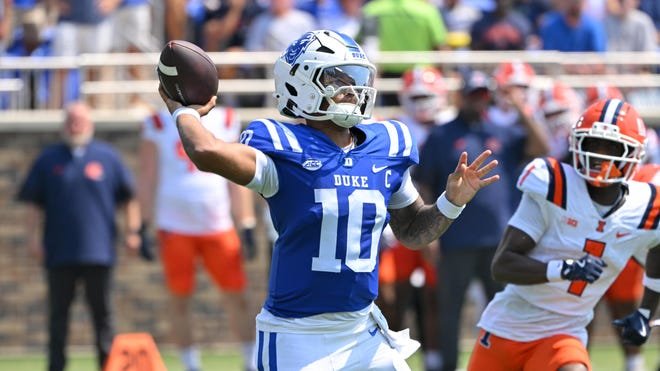
When the news broke last December that Duke had handed out a two-year NIL package worth $8 million to a transfer quarterback, the reactions were immediate — and a little incredulous. First came the shock: Duke has that kind of money?Then the disbelief: And they’re spending it on football?!
But for Duke insiders, this move was anything but random.
“We have aspirations to play at the highest level possible,” explained Greg Pritchard, a former Blue Devils defensive lineman and co-founder of the program’s NIL collective. “That goes against what people might traditionally think of Duke football, but we were very intentional about getting the best quarterback we could.”
That quarterback turned out to be Darian Mensah, the breakout star from Tulane. Once he hit the transfer portal, Duke’s staff immediately graded him higher than any other available signal-caller. Within days, Pritchard and his team had mobilized donors, struck a deal, and secured a commitment that stunned much of the college football world.
Still, Duke’s backers weren’t just cutting checks for hype. As chief football strategy officer Binuk Kodituwakku noted, donors want to see a return on investment. And Mensah’s first real test came fast — against No. 11 Illinois.
The sophomore delivered mixed results: he threw for 334 yards and two touchdowns on an efficient 23-of-34 passing, but also committed three costly turnovers in a 45–19 loss. Head coach Manny Diaz summed it up: “Darian played really well, but he’s still learning lessons about ball security. The positive is he showed, even against one of the best defenses in the country, just how dangerous our offense can be.”
That next challenge? A return trip to Tulane, where his rapid rise began.
A Meteoric Climb
Mensah’s story is nothing short of meteoric. Barely 13 months ago, he was a two-star recruit from San Luis Obispo, Calif., stuck as Tulane’s third-string quarterback. By last fall, he had won the Green Wave’s starting job, led them to a conference title game, and finished as one of the nation’s top passers — averaging 9.5 yards per attempt, the same as Ohio State’s Will Howard and eventual No. 1 NFL pick Cam Ward.
That breakout made him the most sought-after quarterback in the transfer portal. Within weeks, he signed with an agent and set his sights on becoming the highest-paid player in college football. And while the exact figure of his Duke deal remains debated — some say it’s the full $8 million, others closer to $3 million with heavy incentives — either number places him in rare air, alongside names like Bryce Underwood (Michigan), Carson Beck (Miami), and Arch Manning (Texas).
Mensah, just 20 years old, is already living the NIL dream. He owns his own home, bought a Mercedes for himself, a Dodge Charger for his mom, and even launched a foundation to support young athletes in his hometown. “It all happened so fast,” he admitted. “I didn’t even get a chance to sit back and realize how life-changing NIL really is.”
Duke Football’s Bold New Era
To understand why this move matters, you have to look at the bigger picture. For decades, Duke football has lived in the long shadow of its basketball juggernaut. The program had bright spots under David Cutcliffe — six bowl games in seven years — but faded after 2019. Things turned around under Mike Elko with back-to-back winning seasons before his departure for Texas A&M. That left Nina King, Duke’s athletic director, to hire Manny Diaz in late 2023.
Diaz wasted little time showing Duke meant business. His first big splash in the portal was quarterback Maalik Murphyfrom Texas, landing him for about $1 million — more than ten times what previous starter Riley Leonard made before bolting to Notre Dame. Murphy had a solid season, but the staff wanted more mobility, more explosiveness. Mensah checked those boxes.
Behind the scenes, Diaz and Kodituwakku, who once managed salary caps in the Australian Football League, built a systematic approach to roster construction. They crunch numbers, analyze advanced data, and assign dollar values to transfer targets. “We’re always going to be a developmental program,” Kodituwakku explained. “That means we have to be smarter in the portal than most schools.”
Their pitch worked. Mensah was drawn to Duke’s offense — a system built on vertical passing and giving the quarterback control. He committed immediately, without taking other visits, a sign that Duke’s presentation — and its resources — had sealed the deal.
A New Reality in College Sports
Mensah’s story underscores how drastically the landscape of college athletics has shifted in the NIL era. Players no longer have to stick with blue-blood programs to build their brand or land big money. Recent stars like Travis Hunter at Jackson State/Colorado and Ashton Jeanty at Boise State proved you can rise to the top from unexpected places.
Now Duke is part of that narrative.
With Mensah under center, plus new weapons like Harvard’s Cooper Barkate and Oklahoma’s Andrel Anthony, the Blue Devils are signaling they’re ready to compete with anyone. Whether Mensah ultimately delivers on the hype is yet to be seen — but one thing is clear: Duke football is no longer content to play second fiddle.
“Obviously, Duke football isn’t as big as basketball,” Mensah admitted, “but I think I’m here to change that.”
Leave a Reply