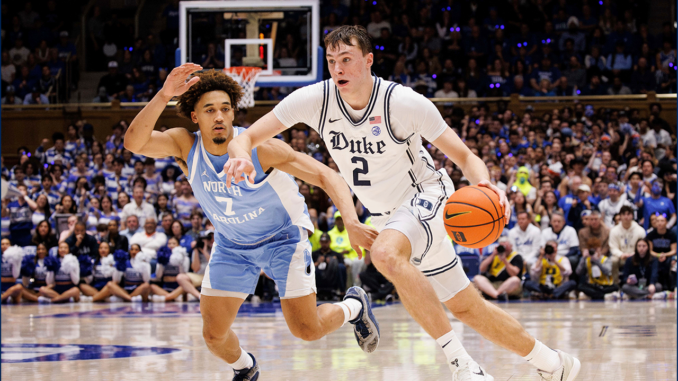
Duke Fans Know UNC Isn’t Any Good—And Now AI Just Confirmed It
For decades, the Duke–North Carolina rivalry has defined college basketball. The blue bloods just eight miles apart have traded national titles, Hall of Fame coaches, and unforgettable moments. From buzzer-beaters to Final Four clashes, the Tobacco Road feud is as fierce as any in sports. But if you’re a Duke fan in 2025, one thing has become crystal clear: UNC just isn’t on Duke’s level anymore—and now artificial intelligence is backing it up.
That’s right. In a world where data analytics and AI models are transforming everything from medicine to game strategy, Blue Devils fans can take comfort in knowing their gut instinct has some cold, hard, calculated validation.
The Decline of UNC, by the Numbers
AI models trained to evaluate team performance, roster construction, coaching efficiency, and recruiting momentum are painting a sobering picture for Tar Heel Nation. According to predictive analytics engines used by several college basketball services and insider platforms, UNC projects as a middle-of-the-pack ACC team for the third straight year—a far cry from its traditional powerhouse status.

Let’s break it down:
Roster Instability: While Duke has mastered the blend of elite freshmen, returning sophomores, and veteran transfers, UNC continues to flounder in the portal. AI-powered depth charts show that UNC’s expected 2025–26 lineup lacks both star power and cohesion. The average player efficiency rating (PER) of their projected starting five ranks just 7th in the ACC, behind teams like Clemson and NC State.
Recruiting Lag: Duke enters the season with the No. 3 recruiting class in the country, featuring Cameron and Cayden Boozer, Nikolas Khamenia, and Shelton Henderson. UNC? Their 2025 haul doesn’t crack the top 15. Not only that, but the AI-driven analysis of player impact ratings suggests that none of UNC’s incoming recruits grade out as top-tier game-changers—unlike Duke’s five-star army.
Coaching Metrics: Hubert Davis is a Carolina legend as a player, but his tenure as head coach has been turbulent. Advanced coaching metrics used by predictive models evaluate in-game decision-making, player development trajectories, and recruiting ROI. The results? Davis ranks outside the top 25 among high-major coaches. Jon Scheyer, meanwhile, is firmly inside the top 10, with models highlighting his adaptability and recruiting consistency.
Style of Play & Efficiency: AI analysis of UNC’s offensive schemes reveals a troubling trend: stagnation. UNC’s offensive rating dropped significantly over the past two seasons, and simulations suggest that without a transformative guard or dominant big, they’ll continue to struggle to generate points against elite defenses. Conversely, Duke’s blend of switchable defenders, high-IQ ball movement, and length-on-length matchups allows them to choke out opponents on both ends.
Why AI Sides with Duke—and Why It Matters
One of the primary factors AI uses to evaluate team success is something called Synergy Index—a combination of player compatibility, spacing efficiency, and lineup cohesion. Duke’s projected starting lineup for 2025–26, led by Caleb Foster, Cedric Coward, Cameron Boozer, and Patrick Ngongba II, scores a 92.7 on that metric. UNC? Just 71.4. The model concluded that Duke’s roster is not only more talented but also far more likely to succeed in tight games and deep tournament runs.
And AI isn’t just crunching numbers for kicks. College programs themselves are increasingly relying on predictive modeling to plan lineups, scout opponents, and even guide in-game substitutions. If schools are trusting the math, fans might as well do the same.

The Eye Test (Still Counts for Something)
Of course, Duke fans didn’t need artificial intelligence to know the Tar Heels were in trouble. Anyone who watched the last few seasons saw the cracks forming: poor late-game execution, a leaky defense, and a team that often looked more lost than inspired. Meanwhile, Duke has surged, blending youthful star power with returning veterans and developing an identity rooted in toughness, defense, and elite transition play.
The 2025–26 squad will be one of the deepest and most versatile of the Scheyer era. With seven players standing 6-foot-6 or taller and a potential All-American in Cameron Boozer, Duke looks ready to make another deep tournament run. And UNC? Let’s just say Sweet 16 would be a ceiling, not a floor.
Trash Talk, Validated by Data
If there’s one thing Duke fans love, it’s having receipts. So when Tar Heel fans start chirping about “tradition” or “Jordan,” you can now hit back with data-supported dominance.
“Your coach is in the bottom half of the ACC in win shares per season.”
“Our synergy rating is 21 points higher than yours.”
“Your best recruit wouldn’t even start for our second unit.”
“Our AI simulation ran a thousand seasons—Duke made the Final Four 37% of the time. You? 3%.”
A Rivalry, Rewritten
Does this mean UNC is doomed forever? Of course not. Rivalries ebb and flow. But right now, Duke is not just winning—they’re evolving. Scheyer’s embrace of modern systems, roster construction, and now data-backed decision-making has created a machine that even the most iconic programs can’t match.
The Blue Devils aren’t hoping to be good. They’re built to dominate. And when AI—the most unbiased, emotionless force in sports analysis—says you’re better? That’s not just a rivalry win.
That’s checkmate.
Leave a Reply